
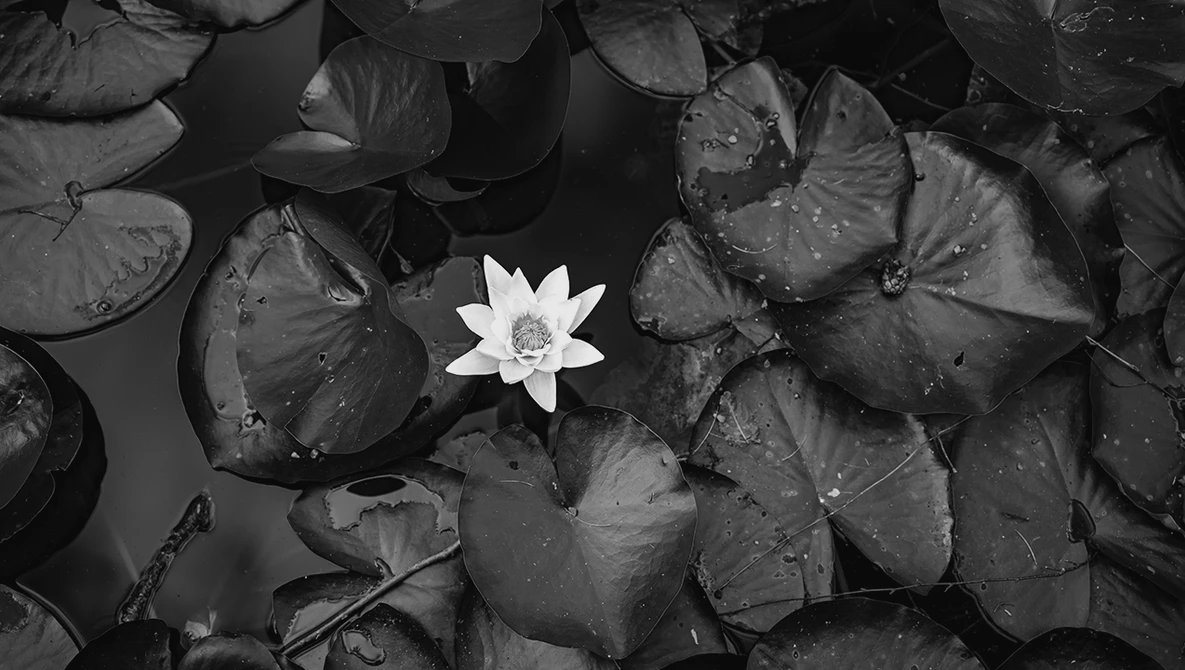
Black and white photography promises seriousness without risk, coherence without effort, and intention without proof. In an era where color is technically trivial and visually unforgiving, monochrome offers shelter. It removes variables, postpones judgment, and replaces unresolved structure with borrowed authority. It is like dimming the lights in a messy room: the objects do not move, but the problems stop being visible. If an image cannot survive color, was monochrome ever a choice?
For years, black and white photography has been framed as a matter of preference. Color versus monochrome meant realism versus emotion and description versus atmosphere. This vocabulary is comfortable because it keeps the discussion safely inside taste. Taste is a soft place to hide, like arguing about music volume instead of admitting the speakers are broken. It allows photographers to declare intention without ever exposing the method. What disappears inside this framing is not nuance, but accountability. What gets obscured is a basic issue of method: the prior exclusion of color from the image itself.
A recurring pattern emerges when looking closely at contemporary monochrome work. The issue is rarely visual failure. Many of these images are competent, sometimes even attractive. The problem lies elsewhere. Nothing justifies the monochrome here beyond habit, rhetoric, or post-hoc explanation. There is no clear moment where color became impossible—no point where chromatic information contradicted the internal task of the image. There is no scene where color actively breaks the image, no red light that ruins the face, no green cast that collapses the mood. Black and white appears not as a condition of seeing, but as a corrective decision applied after the fact. This is not a stylistic preference. It is a delayed decision posing as an intention. That distinction matters far more than most discussions are willing to admit.
Modern cameras do not struggle with color. Exposure latitude is wide. White balance is predictable. Color reproduction has become banal in its reliability. This changes the status of black and white entirely. What once functioned as a technical necessity now functions as an intervention. Color today fails loudly through mixed LEDs, sickly skin tones, plastic highlights, and harsh neon reflections. When a constraint is no longer imposed by the medium, choosing it becomes a declaration of responsibility. When a limitation disappears, selecting it becomes an ethical and methodological act, not an aesthetic one. That shift is rarely acknowledged, yet it sits at the center of the current misuse of monochrome.
Most justifications for black and white photography appear diverse on the surface. In practice, they collapse into a small number of mechanisms. Different phrases, same operation. Once these mechanisms are separated and examined, the logic becomes difficult to ignore. What looks like a debate about taste is, in fact, a pattern of avoidance. The issue is not preference. It marks the moment responsibility is taken or quietly abandoned.
Perceptual Simplification
The most common mechanism is perceptual relief. Black and white feels better because it is easier to process. This ease is repeatedly mistaken for depth. Like turning down the volume in a room full of shouting, silence feels meaningful even when nothing has been resolved. The same excuses resurface every time. Black and white emphasizes form. It makes the composition clearer. Color distracts from the subject. The image becomes more graphic. Light and shadow feel stronger. The frame looks cleaner. There is less visual noise. Each of these statements describes the same outcome: the viewer has less information to negotiate.
Nothing new has been added to the image. No structure has been constructed. No decision has been sharpened. An entire channel of information has simply been removed. The viewer’s cognitive workload decreases, and that decrease is experienced as quality. What is praised as clarity is often nothing more than relief from complexity.
Form does not emerge when color disappears. Form is produced by light placement, geometry, spatial relationships, and distance. Color cannot erase physical structure. A bad shadow stays bad whether it is blue, green, or gray. If form only becomes legible after chromatic information is deleted, the failure lies in how light and space were organized during capture. Black and white does not correct that failure. It hides it by narrowing the terms of perception.
This is why the phrase “it reads better in black and white” is diagnostic rather than complimentary. Translated honestly, it means the image required simplification in order to survive. Variables were removed instead of resolved. The image feels calmer because complexity has been amputated, not because visual logic has improved.
Perceptual simplification works because it exploits the nervous system. Reduced complexity feels coherent. Coherence feels intentional. Intentionality is read as meaning. This chain is automatic, and monochrome activates it efficiently. That efficiency is precisely what makes it useful as camouflage. The image demands less from the photographer and asks less from the viewer. Ease is misread as depth.
Compensation for Unresolved Capture
If perceptual simplification lowers the bar for the viewer, the second mechanism lowers it for the photographer. Here, black and white functions as compensation. The explanations shift slightly, but the logic remains intact. The color temperature was difficult. The light was mixed. Colors conflicted. The background was too busy. The palette felt chaotic. The yellow lamp poisoned the skin, the green exit sign bled into the wall, the red jacket pulled the frame apart. In color, the frame fell apart. The atmosphere was ruined by color. The light was bad, but black and white saved it. The old saying surfaces again: if the light is bad, go black and white.
In each case, the problem is acknowledged but not solved. It is disabled. Uncontrolled color is not an aesthetic issue. It is a compositional failure. Color becomes chaotic when it has not been organized at the level of lighting, palette, timing, or framing. Removing color does not resolve that failure. It removes the evidence.
This is where the concept of chromatic noise becomes unavoidable. What many photographers describe as “color” is often unmanaged chromatic data: mixed temperatures, accidental saturation spikes, unconsidered background hues. Plastic blues, dirty oranges, fluorescent greens fighting inside the same frame. Instead of being treated as part of the structure, color is allowed to happen. When it becomes overwhelming, it is labeled distracting and removed.
Black and white becomes a trash bin for color that the photographer did not know how to control. Neon signs, blotchy skin, cheap LEDs, ugly reflections all get thrown into the same container. What is framed as refinement is often just deletion. The problem is rebranded as a stylistic choice. The underlying failure remains untouched. This mechanism is particularly seductive because the result often looks better. The image stabilizes. The chaos quiets down. But improvement of appearance is not proof of method. Post-capture correction can rescue almost anything. Rescue does not equal legitimacy. If lighting only functions once chromatic information is deleted, the lighting has failed as physics, not triumphed as art.
False Universalization and Borrowed Seriousness
When an image fails as physics, it often seeks refuge in history.
The third mechanism operates at the cultural level. Here, black and white is used to borrow weight. The language shifts again. Black and white is timeless. It looks classic. It references tradition. It feels more serious. Color feels too modern. The image should not be tied to a specific era. The goal is universality. The frame should feel important. It is a costume borrowed from another century, worn to avoid standing naked in the present.
What these justifications share is an anxiety about specificity. Time, place, and context are treated as threats. Color is removed to avoid dealing with them. The plastic bag, the smartphone glow, the year stamped into the light are quietly erased. Black and white carries a heavy cultural association with twentieth-century documentary imagery—wars, crises, archives, and historical trauma. That gravity is quietly extracted and applied to images that have not earned it. Monochrome becomes a filter of importance. The image inherits seriousness without producing substance, relying on the viewer to complete the illusion through recognition rather than meaning.
What is removed in the process is accountability. Specific color anchors an image to a moment. It situates it in reality. Removing those anchors creates abstraction, which is then misread as depth. Context is erased so that the image does not have to withstand it. This is how emptiness survives criticism by disguising itself as universality. The photograph looks historical not because it says something about history, but because it refuses to admit when it was made. The photograph looks like it belongs to a lineage, even when it contributes nothing to it.

Conclusion
Black and white no longer functions as an atmosphere. It functions as exposure. Contemporary monochrome often operates as a safe house for those unwilling to face the complexity of the real world. In color, you are exposed. Errors in balance, material, skin, and space remain visible. In black and white, everything becomes graphic. Everything looks intentional.
Photography has not changed its nature. It remains the registration of light. Color belongs to that process when it is mastered. When it is not, deleting it does not solve the problem. It postpones it.
Black and white is not a style. It is not a mood. It is either a strict protocol or a convenient mask. It is the difference between fixing a structure and simply covering a collapse with a tarp. If you need monochrome to survive scrutiny, you did not choose it. You can no longer persuade the viewer; you can only testify to your own absence from the process.

71 Comments
Reading your lines ans statements I hear a sttong voice for color photography. That is fine. The most important item in your article is not identified. It remains hidden:
What dou you expect from a photograph? What do I have to deliver from your point of view?
Clarifying that helps your audience to think and follow your idea. Or not. Now it sounds just like a rant over BnW. A loud opinion only. Noise.
As someone who has photographed in black and white since 1972 (Digital since 2005). I say your article is complete rubbish by another self proclaimed internet expert
That's 54 years! My only issue is that with that much experience you only provide compression and zero elaboration. But yes, you can formulate your comment the way you want. Some level of depth would be useful however.
. . . and sometimes, a picture is just a picture . . .
' . . . Black and white photography promises seriousness without risk, coherence without effort, and intention without proof. In an era where color is technically trivial and visually unforgiving, monochrome offers shelter. It removes variables, postpones judgment, and replaces unresolved structure with borrowed authority. It is like dimming the lights in a messy room: the objects do not move, but the problems stop being visible. If an image cannot survive color, was monochrome ever a choice? . . . '
What does this even mean?
You're overthinking again.
You’re right to highlight that many uses of black and white are evasive—especially when it’s employed as a quick fix for technical or compositional flaws.
But the argument doesn’t distinguish between conscious and unconscious choices in black and white photography. It also underestimates cases where B&W is a valid, enriching decision rather than a crutch.
Color elimination can be an act of cowardice. But B&W is a grayscale and you overlooks gray as a nuanced exploration, not just a brutal cropping that erases information to avoid confronting mistakes. Well-executed grayscale (like in Irving Penn’s work or Richard Avedon’s portraits) isn’t a refuge; it’s a complex language in itself.
The piece should contextualize black-and-white for what it truly is: a scale of grays. What we see are varying tones—from pure black to off-white—not just stark contrasts.
Gray is "too honest" because it preserves tonal information (rather than erasing it entirely) and works with a controlled palette, not as a bandage.
Oh dear.
Don't look now, but I think you're projecting again.
I nominate this article for next month's Private Eye Pseud's Corner.
This reminds me of the old Ansel Adams quote, "Boy, are you gonna get hate mail."
What I read is this: Now with digital, seeing in color first due to the medium no longer feels intentional. If that’s what it is, I agree.
When I was younger, I decided to get seriously involved with photography. I already had some experience, but I chose to go back to school and enrolled in an art school where I was living in Europe. I didn’t want to study art, but that was not an option. My teachers all came from a renowned art school in Arles where they had graduated. I hated it and loved it at the same time because I was forced into something from which I could actually extract a lot of technical knowledge. I typically learn more from contradictions than from institutions. It’s not really a skill, but more of a nervous system survival mechanism. Multiple illnesses before the age of one shaped that in me.
My instructors loved flat prints and tones, at least that’s how it felt. There was nothing to learn from that apart from disrupting their comfort and making them face my alternative approach. It wasn’t abrasive, but I challenged their linear process a lot, and that’s where the best learning happened. They had to face me and explain their logic, which came from the way they had been educated in Arles. By not accepting that rule, I was able to learn from those “limitations” and greatly expand my knowledge quickly.
When I moved to New York, I worked for a custom lab. At first I did E6 processing and related work, but eventually they started asking me to reprint some of the work the B&W technician would produce after hours. His prints were flat. When he left, it became my department and I made it grow. The largest prints I made were around five feet wide from rolls. I had a great time, and then I moved again. The point is, I was printing for artists, not myself, and they appreciated that I could adjust to their expectations.
I made my full transition to digital in 1999 while managing the photo department integrated into a pre-press house. That’s where I learned digital processing, color separation, proofing, and even wide-format printing. I could see my work in prints, publications, and even billboards. That was another unique learning curve because I could see my clients’ photographic requests translated onto many different supports.
The first digital back I used actually captured one color at a time and combined them in software, so no motion was possible. But it could also shoot grayscale in a single shot without a filter. That’s when I discovered that, unlike film constraints, digital black and white had no inherent “guts”. It was flat until you decided how to process the files. That changed everything for me. Black and white was no longer a pre-calculated process like choosing a film type, chemistry, processing time, or level of agitation. Once the negative was done, you still had paper or filter grade limitations, enlarger techniques for specific effects, and then the paper processing itself.
Cibachrome alone was always a discovery. Contrast and paper type were critical depending on the subject present on the exposed film.
So shooting in color to later convert to black and white feels somewhat muddy to me. Now you have to see the color version first (except for a few older DSLRs with monochrome sensors — Canon had one at some point). And yes, that can feel disturbing.
I have a similar issue with RGB versus CMYK, where the color gamut is massively different. I am completely at ease with CMYK, while most people avoid that color space as if it were a virus. But with fewer color choices, you actually work more precisely. The noise is limited. Yes, the restricted color range is more limiting, especially with blues and fluorescent greens, but everything today ultimately gets printed in that color space, not RGB.
I think black and white originally felt more substantial because it involved making decisions within constraints, without first seeing a color rendering. That gave it a different kind of weight. With digital, the process is different. You are not bound by limitations anymore, apart from the printing inks. Both approaches work, and the progress made should not be dismissed.
Digital: Capture – Evaluate – Decide – Interpret
Film: Decide – Capture – Execute – Refine
Great comment... thanks for telling us your story. While nailing down intention can be a mix of previsualization before the shutter is clicked, and change of heart after viewing the image later on a computer monitor, skill and craftsmanship tend to evolve over the artist's lifetime from guesswork toward previsualization. My first experience with black and white was a reaction to simply desaturating a color photo, and discovering that I liked the black and white version better. We have to start somewhere.
After about 20 years, I've progressed to a point where I see the black and white image, and its basic tone structure, in my mind from the start. For the large majority of my black and white photography, the decision to render an image that way comes first. Yes, the image is captured in color first, but I essentially ignore that aspect until I'm working within individual color bands on the computer for controlling tones and contrast. Converting from color is not a disturbing process for me because, not having learned in the film era, what we have digitally is all I know. It's a conscious choice from the beginning, though, and I'm not sure what constitutes intention more than that.
Explaining the emotions from viewing a fine black and white print is like looking at anything else someone might consider beautiful: a human being, a bird, a watch, a flower, or even the immense pleasure of listening to a song. You don't need logic or any of your theory to appreciate something beautiful. You only need eyes or ears and a heart.
gasp! Sometimes Black and white saves an overexposed image! Film at 11!
Interesting opinion. Complete bollocks, but interesting.
"bollocks", an interesting word that I, as an American, have no context for understanding. I assume it is not complimentary though.
It means complete nonsense, in this instance. Or self-important bullshit, as someone else noted.
"Bollocks! - Yeah, my sentiments exactly." from Mamma Mia! (2008). Although more a term of annoyance than rubbish or nonsense in that context. Not sure what I found so compelling about that movie but I've watched it numerous times. Kind of like a still picture, if we could only define explicitly what causes the viewer to return over and over again...
The purpose of black and white photography is not to rescue a wretched color image that you don't know what to do with. Black and white is a discipline unto itself. The only reason to say what you say is that you don't take it seriously, but only as an after thought. Many of us think in black and white and work with film in a real darkroom, and for many of us digital is used as a matter of convenience. In these cases making an elegant statement, or a powerful statement is most effectively done using black and white images.
And BTW, while I do enjoy the convenience of working an image on my desktop, and while an ink jet print is highly convenient, the darkroom produced print is still a superior expression as compared to even a very well printed ink jet print. Side by side you can see the difference.
what self-important bullshit
?
Says you. Because you disagree, or you don't agree doesn't make it BS. That is your viewpoint, probably because you've never actually worked in a darkroom or made an actual darkroom print. And since you have nothing posted on this page I conclude that you are just another BSer. If you're going to engage in conversation here it would help if you showed some work so we could evaluate the validity of your comments.
.
Rex had no content in his reply, only a rant not pointing at anything . That's called compression. "?" was a compressed reply. Sorry you missed that but it was the best I could do with nothing to start from him in the first place. I gave you the ultimate compression I could, "." because you defended a person who technically said nothing.
You will probably discover the irony of your insult toward me after you finally read my comment from two days ago.
Not certain I understand. No insult was directed at you, rather directed at someone who interjects a dumb comment with no imagery to back it up. And no, I did not understand the compression comment. I actually spend very little time on the interweb since I have learned that people say outrageous and intellectually indefensible things just to get a rise, or a comment, so I am not completely comfortable with some of the rhetoric. They must be truly starved for attention. So it was not directed at you but at Rex, who has no ground to say anything, and cannot say anything of substance.
Keep digging yourself deeper, it's becoming actually interesting to witness.
Interesting... I've heard of a lot of uses for the word compression, but never as a description for a short compact statement, or what you call a rant. Rants can actually be quite long. Compressing a longer version of text into a shorter version though would make sense. I'm sure some readers would prefer that I compress what I have to say into something shorter... like in so short that it didn't exist.
Your use of the word "compression" got me to thinking about its many usages. There is data compression which takes a large file and turns it into a smaller one, jpeg for example. Compression is also used in music, medical care, biology, fuel in a combustion engine... a couple examples of which I hadn't thought about before. But whereas a jpeg still leaves the great majority of the image intact to the point of being recognizable, compressing a thought down to the point of a single mark such as a question mark (?) or period (.) eliminates virtually all understanding. Some people actually replace text with a couple dots when they would have preferred to delete their comment altogether, but Fstoppers does not allow that.
So I Googled the meaning of a single dot in text conversations, and here was its answer:
A period all by itself in slang—usually sent as a single-character text message or used to end a sentence with extreme finality—means "and that's final," "end of discussion," or "I'm not arguing about this anymore." But your single dot was not final... there was more to come.
BTW, the meaning of a mark by itself also got me to thinking about use of initialisms in general. About the only one we used in my generation, before texts and DM were invented, was ASAP. Except my dad never said ASAP, he said "get your lazy ass in gear and do it right now." BS was another, and actually goes back to my grandparent's generation. Makes me chuckle to think of my grandmother telling my grandfather he was full of BS. Nowadays the list of initialisms is so long and tedious that I need to keep a colloquial dictionary handy. Just when I get used to LOL, some character has to complicate everything with ROTFLMAO.
Lastly, IMO, you've misunderstood Nathan's comment. Not that I particularly like his comment because Nathan and I have our own little history of lighting a fuse to a stick of provocational dynamite, and he's heading down that path, again. Fstoppers writers really don't need to lecture members on how they should write or post images. FWIW, the majority of community members don't show any of their photos. But if you return to the comment, Bee Zee, which you believe was directed at you, the one where Nathan begins by saying: "Says you. Because you disagree, or you don't agree doesn't make it BS. That is your viewpoint," he is speaking to Rex. You can tell, ICYMI, by the fact that there is an arrow pointing to Rex's name at the top of that comment. You may have thought he was criticizing you since his comment followed underneath your comment, but he is being critical of Rex, not you. G2G.... the refrigerator is calling.
Oh! you are correct, I owe Nathan an apology and will.
Final, for me would be " ". You are correct "." is not empty at all but for people who think linearly, that is the expectation, the default, the extend of their reality. If they enter that space they have no way to go. I’ve been playing with that on forums, and they never reply. Why? Because the value hides both additive and subtractive ways of thinking. Most people cannot sustain cognitively the process of subtractive. That requires strong somatic understanding. So “nothing” doesn’t question anything, but a “.” as a reply implies that there is something present. I would assume that internal contradiction is what triggers sympathetic arousal but unconsciously, the brain rejects entering that state.
The same way, often Alvin’s articles seem to contain these types of contradictions. Only they are not. He uses a different perspective looking from the outside. Any reader who assumes the opposite finds automatic conflict. Their sympathetic arousal gets triggered. They get mad, angry, try to find closure by making short replies clearly showing an intent to show no depth at all. That’s avoidance, a shut down. They don’t have to make the comment but their nervous system can’t recalibrate without representation. You can see that when they receive a lot of thumbs up from people who express the same view with limited depth in their replies. It’s a pattern. They all feel relieved not by reality. They use the perception of societal acceptance to do so.
You on the other end, allow depth. It doesn’t mean that you don’t conflict with Alvin, but you regulate better and become curious. That’s depth and you clearly don’t fall into linearization. I stop short to name it linearization trap because linear thinking is actually totally normal for proper nervous system regulation. Neither has to do with intelligence, more about capacity to sustain regulation.
The issue at heart in my opinion, is when people follow societal expectations too rigidly. Even creative people can fall into this. Routines over time can influence this for example. You see that in replies. “I did this since the 70’s, it has worked for me therefore why should someone have a different perspective on it. I have settled this in myself so the other is wrong and I don’t have to elaborate to justify my position”. That’s very static, assuming that everyone evolves the same way. In reality if this was true, the world would be extremely boring. We are getting into this with social media, but that’s another topic.
I don’t object to people who use compression for replies and the mini support thumb up group thinking that ultimately follows. By no mean is that any form of contribution. But it is seen and noted. Alvin’s articles are not about closure. That’s what makes them interesting. If it’s too much for some, they clearly don’t have to engage.
I appreciate your note on my mistake
Nathan, Ed showed me where I got side tracked and addressed you erroneously. My apology for being so persistent with my mistake. I was actually surprised by it because you tend to elaborate with full comments and that bothered me too. I certainly jumped and reacted too fast without checking.
not an issue. It's what I thought.
As to being thorough; I was not. I have been very busy taking care of some friends that have had a very difficult thing happen + my normal art and business commitments. So time is a premium and there was nothing I could add to the conversation that hadn't been said in terms of an analytical comment. Only to express my displeasure. Sad part of it all is that he gets paid for the rants of the commenters here.
I don't think Rex does, but Simon appears to. Simon appears to stand and force closure in the few articles I scrolled through. His approach is different, definitely more technical.
These bad contributions are actually the ones that flatten conversation, make people not want to contribute or even come back. That's how people are leaving social media for example. Go to a book store right now and see how active they are becoming again. There is more freedom there, you decide what you want to read, you make your opinion on the book and no one is there to tell you otherwise.
Force closure? Interesting. 🤔 Maybe some things simply need to be expressed, and don't need to be drawn out into a debate?
I don't know why you are commenting then...
"Simon appears to stand and force closure in the few articles I scrolled through." You lost me there. What does that mean?
Sorry Ed, he could have asked, decided not to. I can private message you, that way I don't draw out a debate here.
There was a question mark, or two, in his comment. Having been a participant to several discussions in Simon's articles, I doubt he will mind. He seems more the type, in my opinion, to draw things out than shut them down. Other Fstoppers writers seem quite indignant if you challenge their work, or ignore you completely... Simon is not one of them. Indeed, one of his articles last summer drew 161 comments. And I prefer to call them discussions rather than debates. Sounds a little more constructive. If we can't venture a little off topic or expand the subject, I see no point in having these discussions, or debates, or whatever you want to call them.
Thanks Ed. I'm always happy to discuss photography topics, and the comments section is a great place to do so. I prefer it to places like Facebook Groups.
"Force closure?" is basically asking what you mean.
Ah! no closure yet... so you keep replying. What’s the word? interesting.
My point was that you couldn’t find closure with the article above so you vented and left without explanation. If I see patterns you can’t, it doesn’t mean I’m wrong. May be next time you can limit the language or simply resist entering the space. I understand the impact of decompressing very clearly, thank you.
Interesting maybe to a psychiatrist, but probably not much interest to anyone seeking a discussion pertaining to photography.
Fair, neither does "complete nonsense, in this instance. Or self-important bullshit, as someone else noted". But I did produce a contribution 7 days ago. The guy I responded to hasn't even started after 5 comments.
Why is it that people like yourself, continually wanting to argue and criticize others, have no profile photo, don't use their real name, and don't show any of their work? Now that is interesting, because I wonder what they are trying to hide? This comment is my closure, have a nice day. 🙂
If you come back and read this, you know you haven't found closure.
What "closure" has to do here with anything beyond personal attacks has largely escaped me. It was not until a moment ago that I remembered how people use the word itself connected to funerals. In that case, closure is more than just an end for the sake of an end. It's a way of acknowledging reality, releasing emotions, and it's actually the foundation for beginning a new life. We don't stop talking about grandpa; we just start thinking about him in a new light.
What we actually experience is one step in life which leads to another step. And during that time, previous thoughts, ideas, and even firm decisions or conclusions often need to be revisited. That's how we make progress. Practically speaking, there is no such thing as an end, a closure, or a period (.) in life.... only commas.
Closure is regulation purely and simply.
-
About the comma: space is empty and neutral. A comma never, that's why they exist.
And if you've learned anything about me, you can appreciate my saying that nothing is simple. You or I can say anything we want, for as long as we want. Only regulated when editors decide it crosses the line into threatening or abusive language. Until that point, there is no regulation to what we write. I may no longer find an audience, but I can write to my hearts content if that pleases me. And some people do appear to enjoy writing, even when it appears no one is listening.
I am talking about nervous system regulation here.
As I said... nothing is simple.