
Let's get this out of the way: this is not nostalgia.
I'm not trying to "bring back" anything, especially a smartphone. I'm not interested in retro aesthetics for the sake of it. And I'm definitely not here to argue that older technology is somehow superior.
I use an iPhone 8 because it works for me, and a smartphone for me is just a smartphone — something I use to communicate.
In 2026, that sounds almost irrational. But I am not the kind of guy with a passion for mobile phones. I am still a computer guy, working with my desktop computer at home. For several years, already here in Mexico, I didn't have a mobile phone, and yes, it's not always essential — but I'm a class of 1975, and I can remember that life was possible without a phone all the time.

The Upgrade Trap
Smartphone photography today is built around one idea: more.
More lenses. More processing. More dynamic range. More sharpness. More control after the shot. Every new release promises to fix the flaws of the previous one, pushing us closer to technically perfect images.
But here's the problem: perfection is not neutral.
The more the device does, the less you decide.
Images become smoother, cleaner, more balanced. Shadows open up, highlights are rescued, colors are optimized. Everything looks "better" and somehow, everything starts to look the same.
That's where I stepped out. Also because that is not how I learned to love photography. Photography, to me, includes imperfection.

What an iPhone 8 Gives You (That Newer Phones Don't)
The iPhone 8 is a simple camera.
One lens. Limited dynamic range. No computational safety net worth mentioning. If you miss exposure, you miss it. If the light is harsh, it stays harsh.
There's no illusion of control after the fact.
And that changes everything. It is a simple point-and-shoot.
You start paying attention before pressing the shutter. You read contrast instead of correcting it. You accept that some parts of the image will disappear into shadow, while others will burn out.
You stop fixing. You start choosing.

Why I Use Dazz Cam Pro
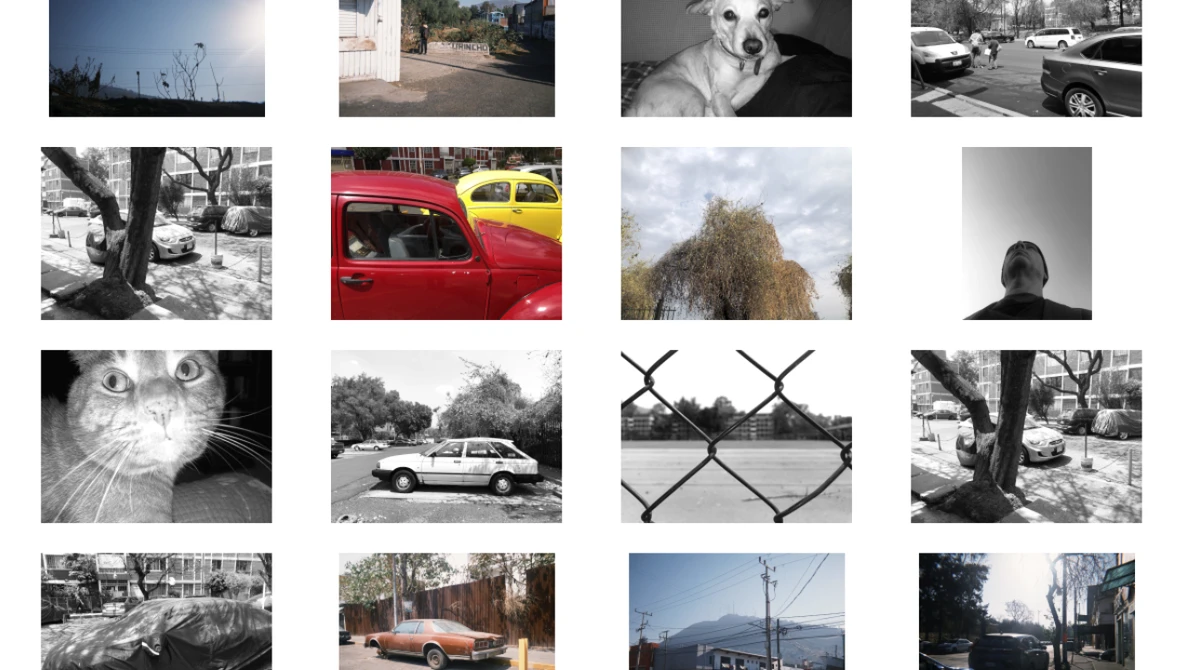
I pair it with Dazz Cam Pro, not to simulate film, but to introduce friction.
Digital photography today is too clean, too predictable. Dazz Cam interrupts that flow. It adds instability: color shifts, edge softness, occasional inconsistency. Not enough to become a gimmick, but enough to break the algorithmic perfection we've grown used to.
It doesn't make the images "better." It makes them less controlled.
I love this app because it offers several virtual cameras to work with. There is also a half-frame camera mode that allows me to create diptychs.

What These Images Are About
The photographs I'm making with this setup are not about technical performance.
They're about space and distance.
A figure standing at the edge of an empty urban area, surrounded by dryness and silence. A person walking away across a wide street, almost swallowed by light and shadow.
Nothing spectacular happens. No decisive moment in the classic sense. No visual trick designed to impress.
Just fragments of reality, observed without interference.
That's what I'm interested in.

The Real Advantage of Using Less
Choosing not to upgrade is not a limitation. It's a filter.
It removes distraction.
There's no comparison to be made, no spec sheet to analyze, no temptation to switch lenses or modes. The tool becomes transparent much faster, and what remains is the act of looking.
And when that happens, something shifts.
You stop thinking about photography as output, and you return to it as experience.

Final Thought
Using an iPhone 8 in 2026 is not about resisting progress.
It's about rejecting excess. Sometimes I go out without a real camera and I have only the iPhone with me.
Because at some point, the question is not how much your camera can do.
It's how much of it you actually need. Sometimes here in the neighborhood, having only my phone can be a refreshing experience — but I'm not interested in relying on the latest super "camera phone" on the market. I know that I don't have the rendering and image quality that the new smartphones offer.
2 Comments
Interesting. I like to play around with this. There are two Dazz Cam apps in the app store. Which is the one you use ?
I use the Dazz Cam - Vintage Camera...the one counting with several cameras, including those for videos.