
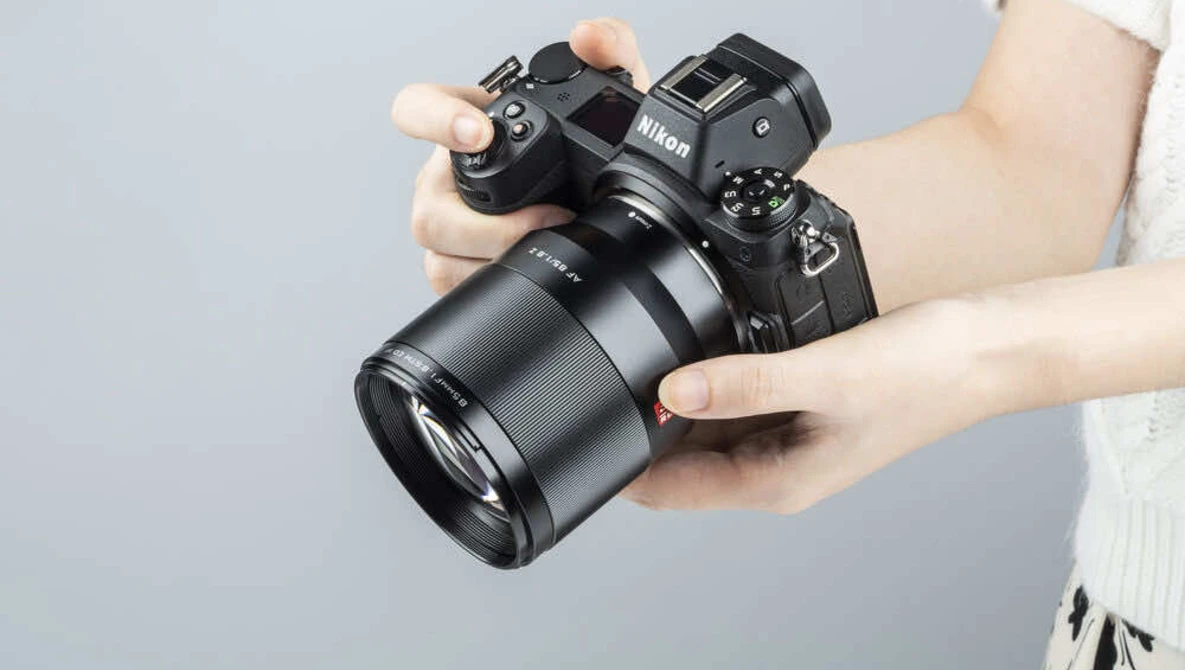
The 85mm prime is the rare lens that almost every working portrait photographer owns, eventually. It is the focal length that does the most flattering work on faces, the easiest one to recommend to a portrait beginner, and the lens most photographers reach for when they want to make a person look the way they want to be seen.
There are usually two versions of this lens in any given camera system. The f/1.4 is the prestige version. It is the one with the metallic name (G Master, S-Line, L Series), the one that gets reviewed at length, the one that photographers post about on Instagram with caption text suggesting that this purchase, finally, is the one that will unlock the next level of their work. The f/1.8 is the working version. It is smaller, lighter, less expensive, and almost always the better lens for almost every photographer who is choosing between them.
The math on this is not close, and the photography community has been weirdly reluctant to say so out loud. So let me say it.
The f/1.4 Is Sold for an Aperture Most People Will Not Use
Here is the contradiction at the heart of the f/1.4 marketing pitch. The lens is sold on the strength of its maximum aperture. The advertising imagery shows portraits at f/1.4 with paper-thin depth of field, dreamy backgrounds, and the kind of subject isolation that only the widest apertures can produce. The reviews emphasize how the lens performs wide open. The whole proposition rests on what happens at f/1.4.
Then the photographer takes the lens home and immediately discovers that f/1.4 is impractical for most actual portrait work. The depth of field is so shallow at typical headshot distances that getting both eyes sharp is a coin flip. The bokeh is gorgeous, but only if the autofocus locked on the exact eyelash you wanted, which it often did not. So the photographer stops down. To f/2. To f/2.2. To f/2.8 for groups, where the f/1.4 lens is now performing in a range that any decent f/1.8 lens can match exactly. Most of the actual frames captured by f/1.4 owners are taken at apertures the f/1.8 lens could have produced, which means most of the price premium paid for the f/1.4 went toward an aperture the photographer is not actually using.
This is not a hypothetical pattern. It is the consistent reported experience of working portrait photographers who have owned both lenses. The f/1.4 maximum aperture is the marketing hook. The actual usage lives one to two stops down, where the difference between the two lenses is much smaller than the price tag suggests.
The Size and Weight Difference Is Not Trivial
Cameras have gotten smaller and lighter over the past decade. Lenses have gone the other direction. The premium f/1.4 portrait primes, in particular, have become enormous, and the weight penalty for that extra two-thirds of a stop is significant.
The clearest example is the Sony pair. The Sony FE 85mm f/1.4 GM weighs 820 grams. The Sony FE 85mm f/1.8 weighs 371 grams. The f/1.4 is more than twice the weight of the f/1.8 for the same focal length. After a four-hour wedding reception, that difference is not a spec sheet abstraction. It is the difference between a tired shoulder and a wrecked one. After a full day of corporate headshots, it is the difference between finishing the session sharp and finishing it making focus errors because your arms are dead.

The size difference matters, too. The smaller f/1.8 fits in bags differently. It is less intimidating to subjects, who tend to relax more around a smaller lens than around a piece of glass that looks like a telescope. It works better with smaller mirrorless bodies where the front-heavy weight distribution of a large lens makes the whole rig uncomfortable to handle. None of these are dealbreakers individually. Together, they add up to a meaningfully different shooting experience, and the f/1.8 wins on every dimension except the one the marketing emphasized.
The Price Gap Is Larger Than the Difference in Output
The financial argument is where the case for the f/1.8 becomes overwhelming. The Sony 85mm f/1.4 GM lists at around $1,800. The Sony 85mm f/1.8 lists at around $600. That is a $1,200 gap for what most working photographers will describe as a five-to-ten-percent improvement in image quality at the apertures both lenses share. The Nikon pair shows similar math: the Nikon 85mm f/1.8 historically retailed around $500 against the f/1.4 at over $1,700.
That $1,200 buys other things. It buys a second body for backup, which most working photographers should own and many do not. It buys a meaningful lighting investment: a Godox AD200 Pro with modifiers, or a small kit of continuous LED panels. It buys a 35mm prime to complement the 85mm and round out a basic portrait kit. It buys a year of Adobe Creative Cloud, an editing tablet, and a backup hard drive system. It buys a workshop or two, or a useful tutorial library, or Perfecting the Headshot along with several other educational resources that will improve the photographer's actual work more than the f/1.4 will.
The argument that the f/1.4 is "worth it" because the image quality is better only holds if the image quality difference matters more than every other thing that money could buy. For a working photographer who is not also a wealthy hobbyist, that calculation almost never favors the f/1.4.
The f/1.8 Often Focuses Faster
This is the part that surprises photographers who assumed the more expensive lens must be better in every dimension. It is not. The Sony 85mm f/1.8 has consistently been reported as having faster and quieter autofocus than the 85mm f/1.4 GM. The reason is physical: the f/1.4 has heavier glass elements that the focus motor has to move, and even the best motors take longer to position larger groups precisely. The f/1.8 has smaller elements, less mass to accelerate, and the focus motor finishes its work sooner.
For studio portrait work where subjects are largely stationary, this difference rarely matters. For event work, wedding work, environmental portraiture, and any kind of photography where subjects are moving, it matters constantly. A lens that locks focus a quarter-second faster captures the expression that the slower lens missed. Across a full shoot, that adds up to dozens of frames the f/1.8 user got and the f/1.4 user did not.

The autofocus advantage is not universal across every brand and every lens generation. Some f/1.4 lenses focus faster than their f/1.8 counterparts. But the assumption that the f/1.4 is automatically faster because it is more expensive is wrong, and photographers comparing the two lenses in a specific system should check actual autofocus benchmarks before assuming anything.
Who Actually Needs the f/1.4
There is a real list of photographers who genuinely benefit from the f/1.4 over the f/1.8, and being honest about that list is the only way the rest of the argument holds up.
Wedding and event photographers who shoot in dark reception venues without flash get a real benefit from the extra two-thirds of a stop, both for exposure and for autofocus performance in low light. Editorial portrait photographers shooting environmental portraits where the wider aperture provides genuine subject isolation against busy backgrounds may legitimately need the f/1.4 rendering. Photographers whose signature look depends on the specific bokeh quality of a particular f/1.4 lens have a defensible reason to pay the premium. Commercial photographers shooting beauty work where the resolving power of the premium glass at the corners matters at large print sizes have a defensible reason. Photographers who own one body, shoot exclusively in the studio, and want their single portrait lens to be the best one available also have a defensible reason.
That list is real. It is also small. Most working portrait photographers do not fall into any of those categories. They shoot in mixed conditions, they value flexibility, they carry gear all day, and they would benefit more from the lighter, cheaper, faster-focusing f/1.8 than they would from the prestige and the marginal image quality improvement of the f/1.4.
The reason the f/1.4 keeps selling is not that it is the better lens for most photographers. It is that the f/1.4 is the lens that signals seriousness. Owning the premium 85mm is part of how working photographers tell themselves and each other that they are serious about portrait work. The f/1.8 does not carry that signaling weight, even when it produces work that is functionally indistinguishable from the f/1.4 at the apertures both lenses share.
If you are choosing between an 85mm f/1.4 and an 85mm f/1.8 in your system right now, the honest answer is that the f/1.8 is almost certainly the right choice. Buy it, take the money you saved, and put it toward a second body, a lighting kit, an education investment, or whatever else will actually move your work forward. The f/1.4 will still be there in five years if you eventually decide you need it. Most photographers, when they get there, discover they did not.

15 Comments
I use my 85/1.4 a lot in low-light indoor corporate event work when ambient light is so low that I have to switch away from my f2.8 zooms to brighter primes. OTOH, when I want something similar but lighter and smaller, I find my featherweight Samyang AF 75/1.8 FE much preferable to an 85/1.8. Owning both allows me to tailor my kit to individual venues and to the fatigue level likely at particular events. I'll pack the 75/1.8 for a job where I expect light to be sufficient to rely mostly on zooms, and the 85/1.4 when I expect to work in very dark conditions. 85/1.8 is, for me, insufficiently differentiated.
This article would have been so truth in the dslr days. Today, in the mirrorless world, it is the ridiculous f/1.2 lenses people crave. :-)
My 85 1.8 is my favorite lens. I, an amateur, really don't need a wider aperture and actually most of the times get the results I want using F 2.2.
If Nikon had an 85mm f1.4 this article would not have been written. There would be praises for it and how superior it is over f1.8. Bias really shines through here.
Also note that Canon does have a f1.4.
Looklike I’m 5% photographer
85 f1.8 sony so much ca I hate to fix it
85 f 1.4 not only better in lowlight also better build quality and control CA
for client who knows camera they thinking your are serious person with 1.4 and amateur with 1.8
1.4 is too shallow for headshot indeed but no one tell you need to use 85 strictly for headshot only the 85 f1.4 will shine with fullbody
Yes I use 50 f1.2 with eye focus no problem
and I waiting 85 1.2 from sigma
Odd, I thought that the f/1.2 was the "prestige" lens. The Nikon 85mm f/1.4 doesn't exist. If it did it would not be an "S lens, that would be the f/1.2 and f/1.8 before it.
Just like the old analogue Days where hobbyist tried impress with big lenses hopen to be seen as a professional by the unknowing bystander...
For those he knew it was what most ladies stated...
It' notthe size of the vessel it's the motion of the ocean 🤭
All facts.
Wish more manufacturers would make f2 primes.
Samyang has a whole series of f1.8 primes - 24mm, 35mm, 45mm, 75mm and 135mm, and I think an 85mm is on the way. I have all but the 85mm and love 'em.
The difference between a 1.8 and a 1.4 lens is less than a full stop since the larger opening number when multiplied by 1.4 will give you the next smaller aperture number. E.G 1, 1.4, 2, 2.8, 4, 5.6 etc are full f-stop numbers. The numbers are actually rounded to the nearest full number except in the case of 1.4, 2.8 and 5.6. So the difference between an f-1.4 and an f-1.8 is negligible and surely not worth the extra $$$$ and increase in size and weight. So when you see a number like f-6.3, or 1.8 they are not a full f-stop larger or smaller than the adjacent number that is a full f-stop number. The intermediate numbers are not much more useful than the larger f-stop number. For instance an f-1.8 lens is only about a quarter stop faster than an f-2 lens. My belief is that the only reason to do that is for marketing hype by the camera or lens manufacturer. Back in the days when the only real professional quality cameras, for whatever that means, and it isn't much, were Canon and Nikon they were in a constant battle of one upsmanship which translated to sales numbers.
"So the difference between an f-1.4 and an f-1.8 is negligible and surely not worth the extra $$$$ and increase in size and weight."
That may be true for you, but it's not for me. As an event pro, I shoot in the dark a lot. BTW, the difference is 2/3 of a stop.
"an f-1.8 lens is only about a quarter stop faster than an f-2 lens"
It's 1/3 stop brighter. F1.7 is 2/3 of a stop brighter.
I know, these numbers don't seem to fit, but these are the numbers used to denote 1/3-stop increments.
I would agree that the f/1.8 is enough. I have the 85mm f/1.8. And I recently purchased a 1.4 because I thought this will be great to have this better lens. But when I started using it I realized it's not a better lens for my portraits. Just as the article says, the focus is just razor thin.
Unless you're shooting with APS-C, where f/1.4 is genuinely useful (depth of field is not as shallow as full-frame), and the lenses are not huge. Look at the compact (but excellent) Sigma 56mm f/1.4 prime, which provides an 85mm full frame equivalent field of view. I do find the f/1.2 APS-C primes from Viltrox too large, though. For full frame the new f/1.8 and f/2.0 EVO lenses look like a great buy, though.
I agree with everything this article says. I also think that it applies to 50mm primes as well. I'm in the Sony ecosystem and don't think that the Sony 50mm f/1.8 is all that good a lens, but I think the Viltrox 50mm f/2 Air is a great lens and a very affordable one at that. With respect to 85mm, the Viltrox 85mm f/2 Evo is another great choice especially if you don't like the CA or Sony's 85mm f/1.8. There are a lot of choices out there and many of them are not high priced and give spectacular images! I do a lot of travel photography and I do understand the need for fast apertures sometimes, but f/1.8 or f/2 isn't all that slow. I admit, I do have the 35mm f/1.4 GM and it is great in low light, but at 521 grams it's also not a beast to carry. True, it's heavier than several alternatives, but not crazy heavy either. If it's about the image, crazy fast apertures are way too often just hype.