
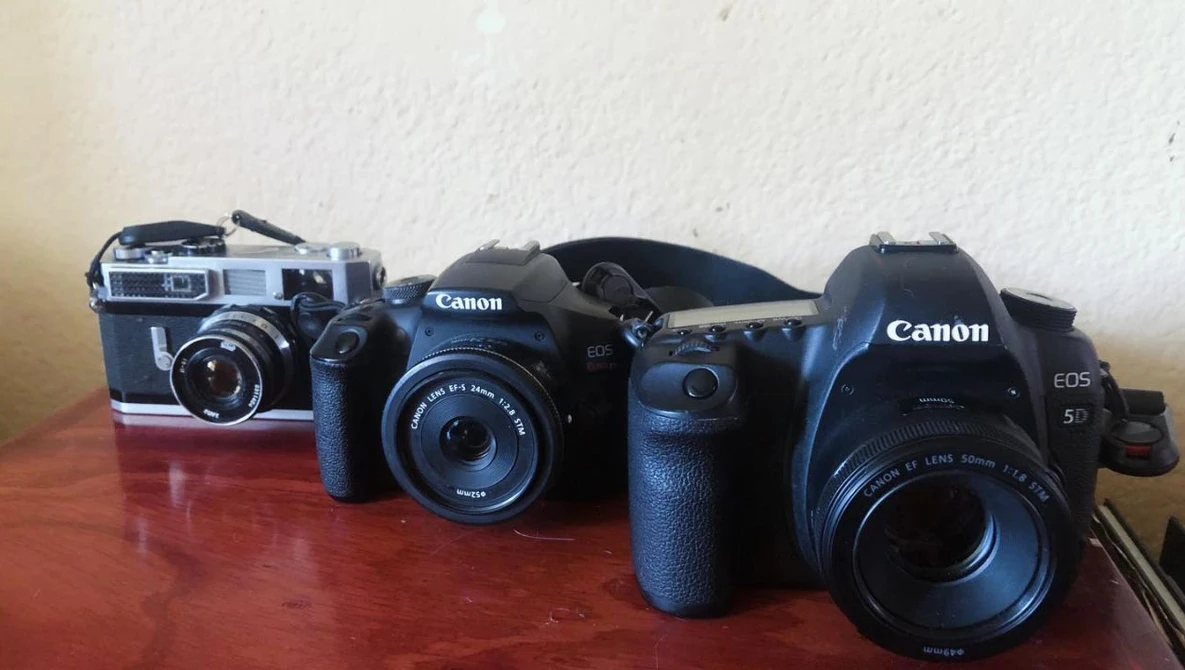
I was an early mirrorless adopter. Not in the “influencer early” sense, but back when using mirrorless for professional work still meant explaining yourself. Other photographers said I was crazy, that I was just betting on a passing technology.
Around 2010, I switched to mirrorless because it made sense to me: smaller cameras, lighter kits, fewer mechanical parts, and a clear direction toward the future. For years, mirrorless systems were my primary working tools. Over a decade, I have worked with cameras made by Panasonic, Olympus, Canon, Ricoh, Leica, and Fujifilm.
Then, in 2020, I went back to DSLR. Yes.
That decision tends to confuse people, especially those who see technology as a straight line forward. But photography, at least in my experience, doesn’t move that way.

Mirrorless Didn’t Fail Me. It Changed My Behavior.
This isn’t about image quality. Mirrorless cameras are extremely capable. Autofocus systems are better than ever, sensors are clean, and dynamic range is impressive. I still have mirrorless cameras.
The issue wasn’t what mirrorless cameras could do. It was what they made me do.
I found myself checking screens more often, trusting previews more than my judgment, and staying mentally connected to the camera instead of the scene. The constant availability of confirmation changes how you shoot, whether you admit it or not. That’s on me, and I’m not pretending it works that way for others. In fact, I know it can be the exact opposite.
But for me, with a DSLR, that layer disappears.
You don’t see a simulation of the final image. You see the world, just like with a film camera—light as it is, not as the camera interprets it. That difference is subtle, but over long periods of work, it matters.

In 2020, I Needed Less Technology, Not More
Most of my work happens outside controlled environments: streets, public spaces, real people, unpredictable situations. I’m not talking only about street photography; I include my fashion street style, portraits, and documentary coverage.
I don’t need a camera that asks for attention. I need one that stays out of the way.
A DSLR does that naturally.
No constant previewing: I know it’s possible to turn off the immediate preview of the result, but I also mean the effect of looking through the viewfinder. No temptation to adjust after every frame. No artificial brightness in dark situations.
I shoot, I move on, I stay present. I am in the scene. That is the most important thing to me. The photograph is already behind me, mentally, and I am ready for the next moment.
That mental economy became important to me.

I Didn’t Go All In Immediately
I didn’t abandon mirrorless overnight. At first, I went back using a single DSLR: a Pentax. Almost as a personal test.
I expected it to be temporary, also because I was still an ambassador for a camera manufacturer at that time, and they had immense success by focusing their entire market on mirrorless cameras.
Something happened, because I noticed I was calmer using a DSLR. More focused. I kept the camera on for entire sessions. No overheating. No unexpected standby behavior. Battery life stopped being something I thought about. Believe me, that was an amazing plus after many years with mirrorless cameras.
Eventually, I returned more decisively to DSLR systems, especially Canon. Not flagship bodies, not high-end status symbols—entry-level and mid-range cameras, tools I could trust without constantly thinking about them.
The results didn’t suffer. If anything, they became more consistent.

I Don’t Want to Look Like a Photographer
Mirrorless cameras have become part of a visual culture. They signal being current, optimized, efficient. There’s nothing wrong with that, but it’s not something I’m interested in projecting. I did it in the past—not anymore.
Because I totally get, believe me, the idea of “wearing a camera” that looks cool. But that need disappeared, ironically, when I purchased my 35mm film rangefinder Canon 7, a totally mechanical, super-cool camera that I enjoy working with when I want to shoot a roll. Fact is:
I don’t want to perform photography. I don’t want my gear to be part of the message. I don’t want to look “cool.”
DSLRs are boring for many, and that’s a strength. They don’t draw attention. They don’t suggest luxury or novelty. They don’t ask to be admired.
They just work. And doing the job is my priority.

Ethics, Context, and Comfort
I often work in poorer places and socially fragile environments. Carrying gear that looks expensive or fashionable feels out of place.
With a simple DSLR, I feel more comfortable and, frankly, more ethical. Even in rough neighborhoods, even in places where discretion matters, I don’t feel like I’m carrying a luxury object.
That sense of ease affects how you interact with people. And that affects the photographs.

About Resolution and the Myth of Progress
Twenty-four megapixels are enough for me. They’ve been enough for years. Everything beyond that, for most photographers, is marketing.
A strong photograph from 25 years ago doesn’t become weaker because technology improved. Meaning doesn’t expire. Vision doesn’t get outdated.
If someone needs a $6,000 camera to justify their work, that already says something. I am a working and published photographer, selected by important international brands through their art directors. That says more.

Cameras Don’t See. Photographers Do.
If I can produce stronger work with an entry-level DSLR than someone using a top-tier mirrorless camera, it doesn’t make me special.
It makes the point obvious.
Mirrorless systems promise control and assistance. DSLRs demand intention and responsibility.
They don’t protect you from mistakes. They don’t correct your decisions. They force you to commit.
Exactly like photography has been practiced for more than a century.

One System, One Aesthetic
I need to do everything with the same cameras and lenses: street photography, portraits, sports, documentary work. I care about consistency and aesthetic coherence.
DSLR systems still allow that without constant upgrades, without rethinking workflows every couple of years, and without turning photography into a software ecosystem.
If you want a structured way to strengthen that “all-around” consistency across genres, The Well-Rounded Photographer: 8 Instructors Teach 8 Genres of Photography is a solid reference point.

This Isn’t About Going Backward
Going back to DSLR wasn’t a rejection of progress. For me, it was a conscious subtraction. Less is more, right?
Less distraction. Less noise. Less dependence on technology.
More attention. More presence. More trust in my own decisions.
When everyone moves in the same direction, sometimes the most productive move is to step aside, reassess, and choose differently.
In the end, only one thing matters:
The result.
Not the specs. Not the trend. Not the tool.
Just the photograph. Because, in the end, it’s the photograph we see—not the camera I used to make it.

68 Comments
Do whatever makes you happy. But I don't follow how an SLR makes you "look less like a photographer" than a mirrorless camera would. Most mirrorless cameras and lenses are much smaller than comparable SLR counterparts.
Some clients wrongly believe that a bigger camera body produces more professional images. It's really stupid but some clients really do hire based off of that dumb presumption.
Yeah, that belief definitely exists, and you ignore it at your own risk.
It is a superficial assumption, but it comes from a place most clients can’t escape: they don’t understand the process, so they look for visible signals of “professionalism.” Bigger camera, bigger lens… it feels more serious to them.
That said, I wouldn’t dismiss it as just stupidity. It’s part of the job to manage perception as much as results. In some contexts, showing up with a more “impressive” setup can actually help build trust faster. In others, it can get in the way completely.
At the end of the day, the real skill is knowing when to lean into that expectation… and when to quietly ignore it.
My canon EOS 90D would run circles around those mirrorsless cameras.
In what way? I admit I've never shot one, but the DP Review of the camera says the AF when used through the optical viewfinder isn't very accurate and the camera is best used in Live View mode. Yes, like a mirrorless camera. Not looking for an argument, just curious.
That’s actually one of the biggest misconceptions about the camera. The AF system through the optical viewfinder is not “bad” in the real-world sense people online often imply. It’s simply not designed to behave like a modern mirrorless camera with eye detection and edge-to-edge tracking. We really need to stop to look an image 400% on a monitor. What many reviewers noticed is that the AF module can require fine tuning depending on the lens, especially at very shallow depth of field. But once calibrated, it’s perfectly usable and in many situations extremely reliable. Sports, documentary work, weddings, photojournalism… people used cameras like this professionally for years without problems.
The thing is: with DSLRs, the shooting experience itself is different. You anticipate more. You commit more. You are not staring at a hyper-processed EVF with constant AI assistance. For some photographers, that limitation actually creates a more focused way of working.
And yes, Live View AF on that camera is excellent because Dual Pixel AF was genuinely ahead of its time. But saying “therefore you should only use it in Live View” is like saying a Leica M should only be used with an external monitor because rangefinders aren’t technically as accurate as modern autofocus systems.
The OVF AF is not trying to be mirrorless AF. It’s a different photographic rhythm altogether.
A bigger body gives more control no a better image. Mirrorsless camera are too small for my hands
You are right, but also: after extensive experience with small, lightweight cameras, I have to say that it's not simply a matter of greater control and ergonomics. A very small and light camera for street shooting can also become a problem. The lighter the camera is, the less natural stability you get while shooting, especially in fast, reactive situations. That means you’re actually more exposed to micro motion blur and shaky frames, even when your technique is solid. In many situations, you end up compensating by increasing shutter speed more than you normally would with a heavier camera body. Lightweight cameras are great, but they also require precautions that people rarely talk about.
uh....what? Hold a Nikon Z9, Canon R1, or Sony A1 II and tell me those are small.
Not said all the mirrorless are small. Or you read that?
Responding to Talmeed Levi who made the claim that mirrorless cameras are too small for his hands.
uh, OK. In fact the big issue at a certain point I started to see is these mirrorless cameras that are back to be big. I really don't get the sense: the first reason why they started to propose mirrorless cameras was because of being lighter and smaller, the first micro four thirds...after that they back to be big and heavy, sure not big and heavy like a DSLR, but... I loose the beauty of the experience with a OVF and the different workflow and at the same time, the experience is totally computational...just like a smartphone...I know that new generations can't get the difference, but...there is a difference.
Fair point, but I think you’re taking it a bit too literally.
It’s not really about the physical size difference between DSLR and mirrorless. In many real-world situations, both can still read as “professional camera” to people around you. The reaction I’m talking about is more psychological than technical.
In the street, perception matters more than specs. Sometimes it’s not about being smaller, but about how visible and intentional you appear. Even subtle differences in how a camera is handled, how quickly it comes up to the eye, or how “serious” it looks in a given context can change people’s behavior.
So yeah, on paper you’re right. In practice, the line between being noticed and being ignored is often thinner, and stranger, than just dimensions and weight.
I say that because I get better battery life
I got involved early on with professional grade digital cameras. When mirrorless came out, I waited but got more interested when the R5 came out. The original over heating issues forced me to take a serious look at the true advantage it would produce for my needs. Eventually I realized that since most of my work is tethered I would lose batteries fast and adding a second wire for power supply would limit me physically. It became more complex since I had no intention to replace my lenses and digital view finder had no appeal to me. I just skipped the entire thing, haven't lost a client and in fact some have told me I made a good decision. In fact the 5Dm4 was still available in 2025.
Man battery life was a big one for me. When I switched to mirrorless i saw my average battery life drop by half. That's with all the extra bits turned off too. It was REALLY bad in the early days of the internet where I might get maaaybe 100-150 shots on one battery charge. I own more batteries now than in ever have. Now I can get about 300-400 shots per charge but still, on my DSLR's I could get thousands of shots on one charge. FULL days on one battery sometimes two on older DSLR's. I still think the switch was worth it though because AF speed and accuracy is absolutely insane in modern mirrorless cameras. My Zf can focus faster and more accurately in low light than any DSLR I have ever owned. I just wish it could last shoot on one battery. I still have and use DSLR's though. I don't think mirrorless will ever fully replace my DSLR's. Especially my D700. I love that thing.
Yeah, what you’re describing is pretty much the real trade-off, no marketing spin.
Battery life is the most honest difference between the two systems. DSLRs were built around efficiency, mirrorless around performance. And when you’re out there shooting all day, that difference stops being theoretical very quickly.
I think what you’re doing is actually the most grounded approach: accepting both sides instead of turning it into a religion. You gain something real with mirrorless, especially AF in low light, that’s not hype. It does change what you can get away with. But you also pay for it in energy, and sometimes in simplicity.
And there’s another layer to this that often gets ignored: rhythm. With a DSLR like the D700, you’re not just talking about battery life, you’re talking about a different pace, a different relationship with the camera. Fewer distractions, less dependency on power, more continuity. That matters more than people admit.
The fact that you still go back to it says everything. Not because it’s “better” in a spec-sheet sense, but because it still fits a certain way of working that mirrorless hasn’t fully replaced.
I don’t think one will completely kill the other either. More likely, they’ll keep coexisting in the hands of people who care less about trends and more about how a camera actually behaves in the field.
I can completely relate to that way of thinking.
Too often the conversation around cameras gets reduced to newer equals better, when in professional work the real question is much simpler: does it improve the way you work?
In your case, it sounds like you made a very rational decision. If most of your assignments are tethered, battery consumption and added cable management are not minor details, they directly affect fluidity on set. Once the camera starts adding friction instead of removing it, the supposed “upgrade” becomes questionable.
I also think there’s something important in what you said about not replacing your lenses and not being drawn to the EVF. Gear should serve vision and workflow, not the other way around. If an optical viewfinder still feels more natural to the way you see and react, that matters far more than market trends.
The fact that you haven’t lost clients says everything. Clients respond to reliability, consistency, and the final images, not to whether the camera has a mirror inside it.
Honestly, the 5D Mark IV remains one of those cameras that proved longevity is possible when a tool is already mature. Sometimes the smartest professional choice is not to chase the next system, but to stay with what keeps you efficient and focused on the work.
As someone who works in documentary and street photography, I’ve always felt that the best camera is the one that disappears between your eye and the world. If your DSLR still does that for you, then you absolutely made the right call.
Hi - hobby/amateur photogrpaher from New Zealand here...Love your story...after using a mirrorless Panasonic M43 for some time I went back to using a DSLR, mainly for the "feel".
The mirrorless lacked any soul; lacled emotioanl attraction; and lacked a decent in-the-hand feel.
No regrets since I "down-graded".
Happt days
Rick
Rick, I get exactly what you mean.
People get uncomfortable when you use words like “soul” for a camera, but the truth is… that connection is real. It’s not about specs, it’s about how the camera invites you to shoot.
A lot of mirrorless systems are incredibly capable, but sometimes they feel a bit too clinical, almost like operating a device rather than engaging with a tool. And when that emotional layer is missing, your relationship with photography changes, even if the files are technically perfect.
Going back to a DSLR isn’t a downgrade if it brings you closer to the act of photographing. That tactile response, the weight, the shutter, the optical view… it creates a different rhythm, a different presence. And that affects the way you see.
In the end, the camera you enjoy holding is the one you’ll use more, and more importantly, the one you’ll use better.
So yeah… happy days makes perfect sense.
Completely agree as a long time photographer who’s never given up my Canon DSLRs. I’ve used mirrorless, and the high end Sony’s really produce some goregous photos, but i never thought the massive cost increase to have essentially the same gear in a slightly more compact size, was worth it for me. I mainly do sports photography and didnt want to deal with tons of battery changes and the camera overheating in the sun and all that. The artwork I produce with my canon 80D is good enough to get me into exhibitions and for my customers to pay $2200 per piece so it works for me! 😉 Great article!
I like this. It’s grounded, not ideological.
There’s a quiet confidence in what you’re saying that I respect. You’re not chasing validation through gear, you’re letting the work speak. And if your images are hanging in exhibitions and people are willing to pay that kind of money, then the conversation about “upgrading” becomes almost irrelevant.
This idea that you need to reinvest massively just to stay legitimate… it’s more market pressure than real necessity. Especially in your case. Sports photography is not forgiving, and reliability matters more than novelty. Heat, battery, consistency… these are not small details, they’re the job.
And then there’s something else. When you know a camera deeply, like you clearly know your 80D, it becomes transparent. You stop thinking about it. That’s where things start to happen for real.
Sony, mirrorless, cutting-edge tech… all valid. But they’re just options, not obligations.
What matters is simple, and also brutal: the image either holds, or it doesn’t.
Yours clearly do.
I shoot concerts at night, and to be frank: focusing through a (D)SLR is kind of a crapshoot. Yes I can do it, and yes I've gotten great shots with even an old Konica T3 and Cinestill 800T. I enjoy the experience and yes, the battery life. Many of my old film SLRs have excellent, big and bright viewfinders.
Sorry, my Nikon Zf looks like a film SLR, yet is so much more consistent and reliable on a real (paid) shoot. I enjoy the minimal editing needs of 36 exposures per roll, but not the relative ease of missing focus in dimly lit environments. If the performance in question has good lighting though, as this one did, it is easier to be consistent on focus using older tech.
Konica T3, Konica C/D 135mm f2 @f2.8, probably 1/125 sec; CInestill 800T (C/D stands for 'Computer Designed' which was quite a big deal in 1978 when this gem of a lens debuted).
I get where you’re coming from, and honestly… in your specific context, you’re right.
Concerts at night are one of those environments where reality doesn’t care about nostalgia. Light is unpredictable, contrast is tricky, subjects move fast. In that situation, consistency is everything, especially if it’s paid work. Missing focus is not poetic, it’s just a missed image.
What mirrorless has done, particularly in low light, is remove a layer of uncertainty. It gives you a kind of precision that DSLRs, and even more so film SLRs, simply don’t have. So your point about reliability with something like the Zf is completely valid. It’s not about hype, it’s about hit rate.
But here’s the nuance.
What you gain in precision, you sometimes lose in tension. Shooting a concert with a film body, or even a DSLR, carries a certain risk, a certain friction. And that friction can shape the way you shoot, the way you anticipate, the way you commit to the frame.
I’m not saying one is better. I’m saying they produce different relationships with the act of photographing.
For a paid concert, where the expectation is to deliver consistently, I completely understand your choice. That’s professionalism.
But outside of that, that “crapshoot” you mentioned… sometimes it’s also where something unexpected, something raw, something alive can happen.
So maybe it’s not about choosing one over the other, but knowing exactly when you need control… and when you’re willing to lose a bit of it.
I like this story because im still using my 90D perfect in everyway when i learned about the mirrorsless camera and the subject tracking. My 90D allows me to be the photographer with less AI.I said i buy another one.Dlsr just feels right i really don't need the extra help. I just fixed my rokinon 85mm.
Bruh. The 90D is one of the most incredible cameras ever made. The 90D is super underrated. I'm jealous. I really want one lol.
understand the feeling, really.
There’s something very direct about cameras like the 90D. No mediation, no interpretation… just you, the scene, and your timing. And that can be incredibly satisfying.
But I’ll challenge you a little on one point.
It’s not really about “less AI” making you more of a photographer. The camera, whatever it is, doesn’t take authorship away from you. What matters is what you see, not how assisted the focus system is. You can miss everything with a manual setup and still say nothing… or use advanced tracking and create something meaningful.
The real question is simpler: does the tool keep you connected to your way of working?
If the 90D gives you that clarity, that confidence, that sense of control… then it’s doing exactly what it should. And sticking with it is not resistance to change, it’s coherence.
Also, repairing your 85mm instead of replacing it… that says a lot. It means you’re building a relationship with your tools, not just consuming them.
That’s where things start to become personal.
I agree completely. Tried mirrorless but was uncomfortable with it for a lot of the same reasons listed by the author. Still have a couple of mirrorless but I do not use them very often and only for personal shoots.
I think that’s a very honest place to land.
You tried it, you didn’t reject it blindly, and you understood where it fits for you. That already puts you ahead of most of the noise around this topic.
What you’re describing is something I see often: mirrorless becomes a secondary language. Useful, sometimes even brilliant, but not the one you naturally think in when the work matters.
And that’s the key. Comfort is not a weakness in photography, it’s what allows you to be precise, to react without hesitation, to stay present. If a tool creates even a small layer of discomfort, it can distance you from that.
Keeping mirrorless for personal work also makes sense. That’s where you can afford to explore, to play, even to be a bit inconsistent. Professional work is different, it demands alignment, not experimentation.
In the end, it’s not about choosing sides. It’s about recognizing where each tool belongs in your process… and being honest enough not to force it where it doesn’t fit.
Mirrorless didn't change you. You changed yourself.
That sounds nice, but it’s a bit too clean to be true.
Of course the photographer evolves, that’s inevitable. But tools are not neutral. They do shape behavior, sometimes in subtle ways, sometimes radically. The way you focus, the way you compose, the way you react to a scene… all of that can shift depending on what you have in your hands.
Mirrorless didn’t magically “change” someone, but it can absolutely influence how they see and work. Just like going from film to digital did. Or from manual focus to autofocus.
So yes, we change ourselves. But let’s not pretend the tools don’t push us in certain directions.
The real point is being aware of that influence… and deciding if it’s taking you closer to your photography, or further away.
For me it wasn't the viewfinder, but the increased capabilities of the camera, particularly AF. But changing from DSLR to mirrorless really didn't push me in one direction or another. But that's just me, YMMV, as usual.
Of course is a personal thing. In fact, for me to count with many AF modes is not that important. I am used to work with the central focus point and recomposing so really i don't need tracking AF and other features like that for AF. By using the cameras that way is similar to the experience with the zone focusing technique to me.
I tried two mirrorless systems in the beginning and they had fatal flaws that sent me back to DSLR. To date, only one company has addressed the flaw. In the end, a photo is a photo. A photo is about aperture, shutter speed and ISO. The small number of improvements that mirrorless systems have didn't change that. That being said, I'd still love to get an XD2
I get your point, but I’d push back a little on that “a photo is just aperture, shutter speed and ISO.”
Technically, yes. Fundamentally, photography hasn’t changed. But in practice, those three variables are only the surface. What has changed is everything around them: how you focus, how you preview, how you react in real time, how consistent you can be under pressure.
Those “small improvements” are not always small when you’re actually working.
At the same time, I agree with your experience. Early mirrorless had real limitations, not theoretical ones, real ones that affected the way you shoot. Going back to DSLR in that moment wasn’t being conservative, it was being practical.
And your last line is the most honest one.
You don’t need it… but you’re curious about it.
That’s where most photographers actually are. Not in a war between systems, but somewhere in between necessity and desire.
-
Personally I never truly liked DSLR’s. They were too big and cumbersome, had no real focus aids for manual lenses and having to constantly deal with front and back focus issues was the last straw for me. Each to their own though.
That’s fair, and honestly those are all legitimate criticisms.
DSLRs asked for a certain tolerance. Size, calibration issues, the whole front/back focus dance… if that starts getting in the way, it breaks the relationship with the camera. And once trust is gone, it’s very hard to work freely.
Mirrorless solved a lot of that, especially with manual lenses. What you see is what you get, focus aids are actually usable, and that removes a layer of doubt. That’s not a small thing.
At the same time, it really comes down to what kind of friction you’re willing to accept. Some people prefer the certainty of mirrorless, others are comfortable working through the imperfections of a DSLR because they like what it gives them in return.
There’s no purity in either choice. Just different compromises.
And in the end, the only one that matters is the one that lets you work without second guessing yourself.
I bought a Nikon D800 in 2013 and it's still my only camera. While I've had more people than I can count tell me that I'd love shooting with a mirrorless camera, I would only be persuaded to buy one if I believed it would improve my photographs. And if I expect to improve, it will undoubtedly come from the mind, not the machine.
I've owned two D800's and have many other DSLR's and mirrorless cameras in medium format, full frame, and APS-C. The D800 is still my favorite of the bunch. It's also a killer deal of a camera right now. It's so incredibly underrated. I have no Idea how so many people are sleeping on the D800 as a used option right now. I payed $900 for my first one used and thought that was a steal of a deal. Now you can find them form 400-600 bucks. What a crazy low price for such a good camera.
For me? It’s D850 outdoors/Z8 in studio.
In studio, the Z8’s autofocus? Miles beyond the D850’s and it’s critical the camera tracks a model’s eyes.
Outdoors/Street?
It’s almost always the D850/Zeiss manually focused lenses. Creativity stems from my mind’s eye, and only my eye can visualise the resulting image I’m expecting to create before pushing shutter release
Makes a lot of sense. Virtually nothing in my images is moving which demands better autofocus. If the D800 dies, I'd probably buy the D850, although at about $500 or so for a used D800/810 in good condition, it'll be a hard decision. The D800 might outlast me though.
here’s a lot of clarity in what you’re saying, and I respect that.
But I’d refine one thing.
Improvement does come from the mind, no doubt. That’s the core. No camera will give you vision, sensitivity, or intention. If those aren’t there, nothing else matters.
At the same time, the machine can influence how easily that vision translates into a photograph. Not create it, but facilitate it. Sometimes in small ways, sometimes in very concrete ones.
The risk in your position is not being wrong… it’s becoming a bit too absolute.
You don’t need a mirrorless camera to improve your photography. That’s true. But it’s also true that certain tools can open different possibilities, or simply make certain situations more fluid.
The real question is not “will it make my photos better?”
It’s “will it change the way I work in a way that’s useful to me?”
If the answer is no, then staying with the D800 is not just fine, it’s coherent.
And honestly, a camera like that in the hands of someone who knows exactly why they’re using it… that’s already more than enough.
I have answered both questions.... the same way for several years. I make artwork for people to hang on their wall. I'm not shooting the Olympics. As I understand newer technology, there are no features which would be useful for me in the way I work. I shoot deliberately, taking as much time as necessary in making compositional and editing decisions. My subjects aren't moving anywhere very quickly.... take a peek at my portfolio and that will make more sense.
Software updates are even less enticing than new cameras because of the continual emphasis on machine automation. But speed and simplicity do not work in my favor. Technology is creating a generation of button pushers. Computational photography... let's see what this button does. Presets... let's see what this button does. Everything to make editing faster and easier, but replaces the intention and craft of photography. The finished image may look the same to the viewer, but I prefer my relationship with a machine to limiting it to capturing light and following my instructions. That is my definition of art. I could be using a Rolleiflex, D800, or even a paintbrush and it really wouldn't matter.
Yes, I agree. And you are right when you call for computational photography. Many don't get the difference, but there is a difference. Remembering when I fell in love with photography, when I was a child and everything was absolutely and wonderfully imperfect. For me, and from what I read, for you too, nothing has changed.
I was always happy with my DSLRs. Then I bought an R7 and jumped into a thicket of additional annoyances. And for all that it doesn’t even have the GPS that any $100 phone has. I kept my DSLR, so back I go.
Yes, because is a total different experience.
Hi There. Greetings from a South African wildlife photographer who operates in the wilderness areas of sub-Saharan Africa.... I think I get what you are trying to say, but with great respect to your professional integrity, why do you even care what you look like when you are working/photographing? As for people identifying film/DSLR or mirrorless electronic image capturing devices, I put it to you that only other photographers would notice what gear you are using, and not the clients because they justy want the best bang for their bucks.. In my case nothing like that applies, because my subjects only worry about eating, and procreation of their species....
I honestly have tried to understand your reasoning, and justification to regress, but, again, with deep respect, I can't see any sense in why you would commit this to an article?
But hey man, whatever blows your hair back, and good luck for you travelling in your chosen direction.... So, why did you really write this article?
If I might intrude here... the point of the article transcends the outward appearances of a particular camera. The author writes about functionality and how using a mirrorless camera differs in actual shooting habits and interaction with the camera itself. As someone who has watched the comparison between mirrorless and DSLR unfold over the last decade, I find the article, as well as the comments, enlightening. Certainly the comments by readers here have done nothing to change my mind that I'd replace my DSLR with another DSLR when it comes that time. But it would be the first time in my life that I would purposely choose older technology instead of newer.
You define the answer to your question in your introduction. Wildlife is for the most part unpredictable and for you, extremely fast focus and it’s precision are key. You can shoot brackets as fast as doing a video. The tool for you becomes added flexibility. That becomes your consistency, your rate of success, even your visual memory to determine if you have captured what you positioned yourself to obtain.
Other photographers including those who do street photography might feel that choosing the capture’s instant is more predictable in the environment they operate, therefore less dependent on the device’s technicality.
Ever heard of Emile Leray? He crossed part of the Sahara desert with a 2 wheel drive Citroen 2cv. After a crash that rendered it unusable, he took time to repurpose it into a motorcycle to finish his journey. Had he done it with a Land Rover (new or old) and crash would have terminated any hope to reach destination without major help and replacement parts.
It’s all about vision and adaptation. We all have different needs.